From Seville: Pueblos Blancos, Ronda & Olive Oil Tour
10 hours
A Sierra de Grazalema loop from Seville through Zahara and Grazalema, with an olive oil mill visit and an afternoon in Ronda, but no Setenil stop.
from$89
Check availability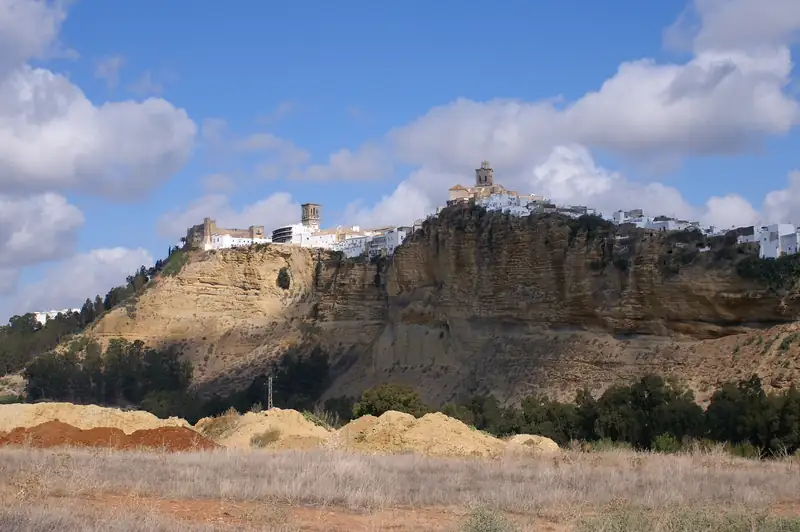
Arcos de la Frontera is a town of about 31,000 people whose old town sits on a sandstone ridge above vertical cliffs over the Río Guadalete. Cádiz's tourism board calls it the gateway to the Ruta de los Pueblos Blancos. It is 35 km from Jerez and about 74 km by road from Setenil.
Arcos de la Frontera is where the white villages meet the plain. Its old town runs along the top of a sandstone ridge whose edge drops in vertical cliffs to the Río Guadalete. Cádiz’s provincial tourism board calls it the gateway to the Ruta de los Pueblos Blancos and says it is considered one of the most beautiful towns in Spain.
It is bigger than the mountain villages, with 31,267 people (INE, 2025), but the part worth your time is the old quarter on the ridge. Arcos is about 35 km from Jerez and 64 km from Cádiz, and about 74 km by road from Setenil de las Bodegas.
Everything climbs to Plaza del Cabildo, the main square at the top of the old town. Its four sides tell you what to see: the side wall of the basilica of Santa María on the north, a parador (a state-run hotel) on the east, the castle on the west and, on the south, the viewpoint.
That viewpoint is the reason most people come: the square ends at the cliff, and you look down the drop to the Guadalete. Travel guides usually call it the Balcón or Mirador de la Peña Nueva. Come early in the morning or towards sunset, when the light is low.
The Basílica de Santa María de la Asunción was built after the Christian conquest over an earlier Visigothic church and the remains of a 13th to 14th century mosque. Its main facade mixes Gothic and Plateresque, the ornate early Spanish Renaissance style. It is the church whose side wall frames Plaza del Cabildo.
Elsewhere in the old town, the church of San Pedro stands on the site of a 14th-century fortress or watchtower from the Andalusí period. Its tower and facade combine Gothic, Renaissance and Baroque work. Walking between Santa María and San Pedro is the easiest way to see the old quarter.
The Castillo de los Duques, on the west side of the square, dates mostly from the 15th century according to Cádiz’s tourism board. It is private property and not open to the public. You see it from the outside only.
Cádiz’s tourism board describes the approach to the old town as very narrow, steep streets that pass under old arches. The whole quarter is a declared Conjunto Histórico, a protected historic centre. Look for the Puerta de Matrera, a town gate the tourism board dates to the 11th to 14th centuries, stretches of the old walls, and the palaces and noble houses along the way.
The streets are tight for cars, so park below the old town and walk up.
People lived here long before the town: the tourism board points to prehistoric and Roman traces at the Sierra de Aznar site. But the shape of Arcos today comes from the Muslim period. It became an independent Moorish taifa, a small kingdom of its own, in 1011. Ferdinand III took possession of Arcos in 1250, and after a revolt by its Moorish inhabitants Alfonso X brought it back under Castilian control in 1264.
Arcos’s Semana Santa is its big event. Cádiz’s tourism board says it is declared of National Tourist Interest, and credits the setting as much as the processions, which pass through the monumental streets of the old town. On Easter Sunday the town holds the Toro del Aleluya, a bull run first held in 1784.
Holy Week moves with Easter, so check the dates for your year.
A few kilometres from town, the Arcos reservoir is used for water sports, and the upper end of it is protected as a natural area, according to the provincial tourism board. It is an easy add-on on a hot afternoon.
If you only have time for one white village, the choice usually comes down to these two, and they suit different trips.
Arcos is a proper town on top of a cliff. You walk up through it to the view, and the reward is the drop to the river from Plaza del Cabildo. It sits close to Jerez and the Cádiz coast and has a parador on the main square.
Setenil is a village of about 2,600 people at the bottom of a gorge, where the cliff is above you rather than below. Its two rock streets, Cuevas del Sol and Cuevas de la Sombra, are roofed by overhangs of stone. It is 19 km from Ronda and most day tours from Málaga and Seville to Ronda stop there, so it is the easier one to reach without a car.
Both old towns are declared historic ensembles. Arcos needs more walking. Setenil gets more coach crowds in the middle of the day.
Arcos is the odd one out on a white villages route. The mountain villages cluster within an hour of Ronda, and Arcos is further west:
| From Arcos to | Road distance | Drive (approx.) |
|---|---|---|
| Grazalema | 48 km | 55 min |
| Zahara de la Sierra | 56 km | 1 h |
| Olvera | 68 km | 1 h 5 min |
| Setenil de las Bodegas | 74 km | 1 h 20 |
| Ronda | 84 km | 1 h 20 |
Distances are our calculations with OpenStreetMap routing; real mountain driving is slower.
That makes Arcos a start or end point, not a stop on a one-day loop from Ronda. Coming from Seville, Jerez or the coast, spend the morning in Arcos, drive up to Grazalema for the night, then do Zahara, Olvera and Setenil on day two before Ronda. Our white villages route lays out both versions, and our guide to things to do in Setenil covers the last stop.
None of the day tours we list stops in Arcos. The small-group tours from Seville go to Zahara, Setenil and Ronda instead; our top pick takes eight people in a van with hotel pickup and a guide at each of those three stops. Another tour visits Zahara and Grazalema. If Arcos is a must, a car is the simplest way. For more options from the city, see day trips from Seville.
10 hours
A Sierra de Grazalema loop from Seville through Zahara and Grazalema, with an olive oil mill visit and an afternoon in Ronda, but no Setenil stop.
from$89
Check availability9 hours
Eight people in a van with hotel pickup, stopping at Zahara de la Sierra, Setenil and Ronda, with a guide at each and 75 minutes in Setenil.
from$107
Check availability9 hours
A small-group minibus that fits down the narrow lanes of Zahara and Setenil, with guided stops in both before a longer afternoon in Ronda.
from$107
Check availabilityPrices and ratings were taken from GetYourGuide and can change. Booking through these links supports this site at no extra cost to you.
Yes, particularly if you are coming from Jerez, Seville or the Cádiz coast. Its old town on a cliff edge is a striking sight, and the climb through narrow streets to Plaza del Cabildo ends at a viewpoint straight over the drop to the river. Half a day covers the old town. It also makes a natural first stop on a white villages road trip.
Its position: a white old town strung along the top of a sandstone ridge with sheer cliffs above the Río Guadalete. It is also known for its Holy Week, which Cádiz's tourism board says is declared of National Tourist Interest, and for the Toro del Aleluya, a bull run held on Easter Sunday since 1784. The tourism board calls Arcos the gateway to the white villages route.
Not inside. The Castillo de los Duques, which Cádiz's tourism board dates to the 15th century, stands on the west side of Plaza del Cabildo and is private property, not open to the public. You can see its walls from the square and the streets around it. The square's viewpoint, the basilica and the church of San Pedro are all close by.
By road, Arcos is about 74 km from Setenil de las Bodegas, roughly an hour and 20 minutes, and about 84 km from Ronda. Grazalema is the nearest of the mountain villages, about 48 km away, and Zahara de la Sierra about 56 km. That makes Arcos a better start or end point for a two-day route than part of a one-day loop from Ronda.
Spring is best: Holy Week brings the processions through the old town, and the weather is mild before the summer heat. Arcos sits at only about 185 m, far lower than the mountain villages, and the walk up is steep, so in summer go early. Early morning and evening are the best times to walk up to Plaza del Cabildo and the cliff-top viewpoint.
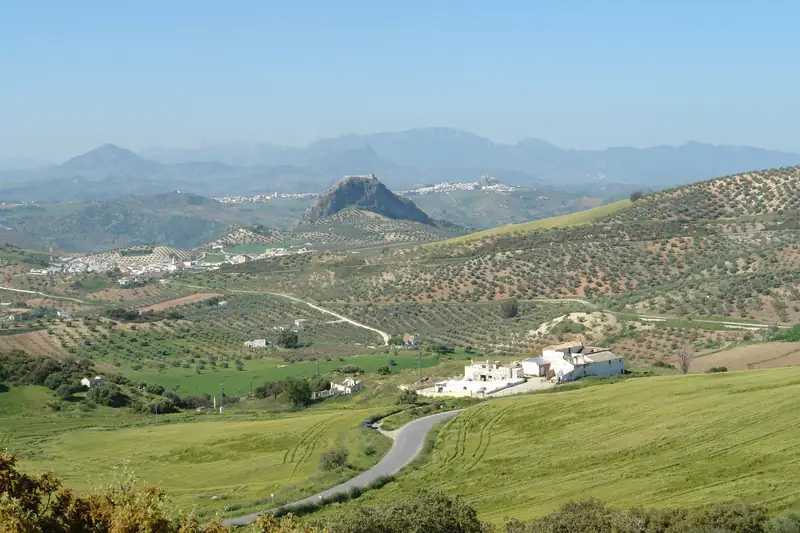
The white villages of Andalusia, or pueblos blancos, are hill towns of whitewashed houses in the mountains between Ronda, Seville and Jerez.
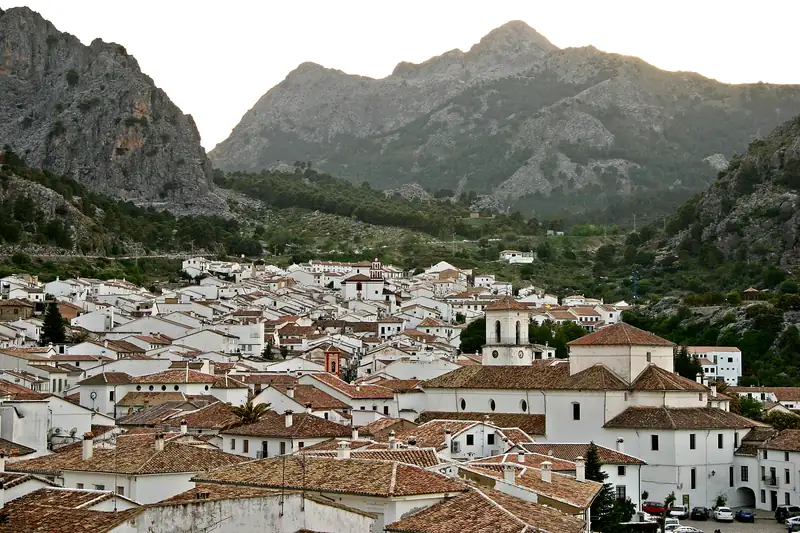
Grazalema is a mountain village of about 2,000 people inside the Sierra de Grazalema Natural Park, 31 km from Setenil.
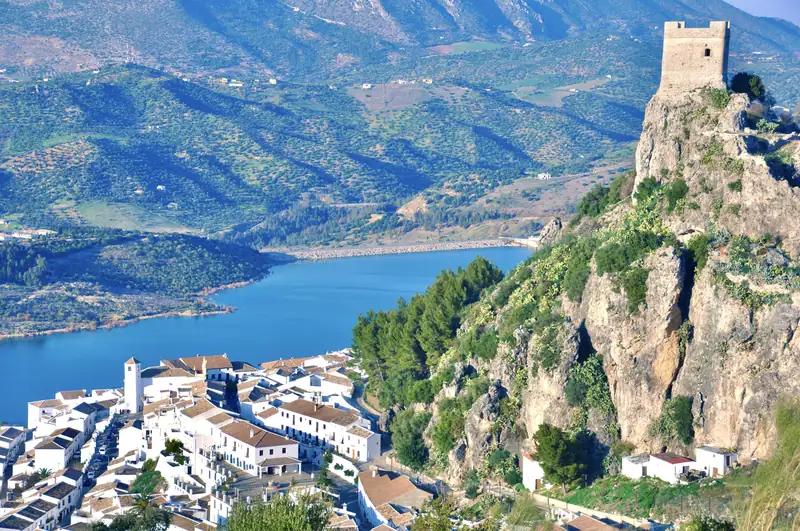
Zahara de la Sierra is a white village of about 1,300 people on a hillside inside the Sierra de Grazalema Natural Park, crowned by a 13th-century Nasrid castle and overlooking the turquoise Zahara-El Gastor reservoir.
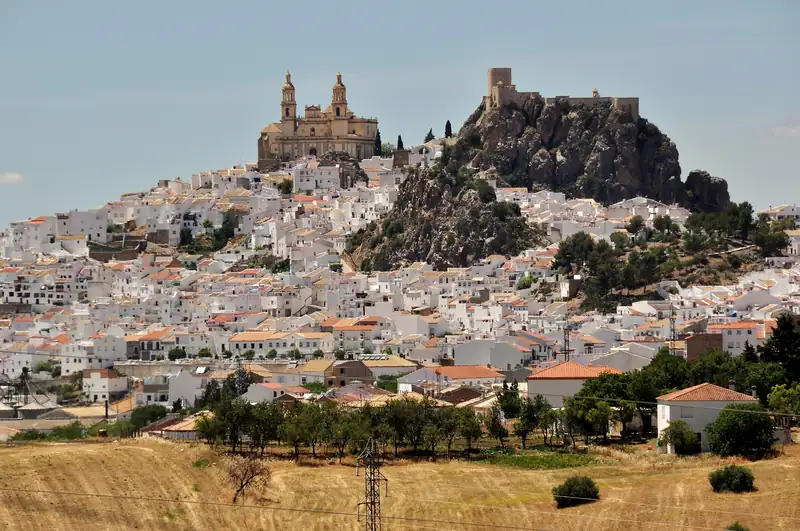
Olvera is a white town of about 7,800 people in the Sierra de Cádiz, 15 km from Setenil de las Bodegas.