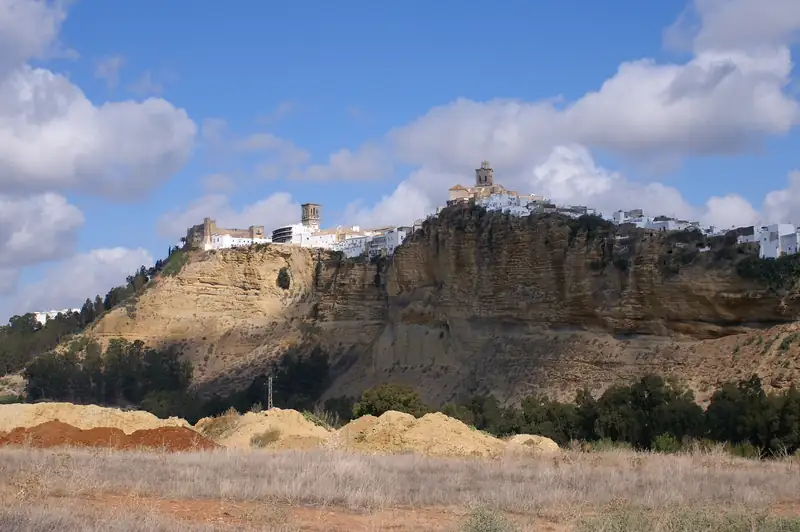
Olvera is a white town of about 7,800 people in the Sierra de Cádiz, 15 km from Setenil de las Bodegas. Its Moorish castle, built in the late 12th century and taken by Castile in 1327, sits on a crag above the town. A €2 ticket covers the castle and the La Cilla museum (checked October 2026).
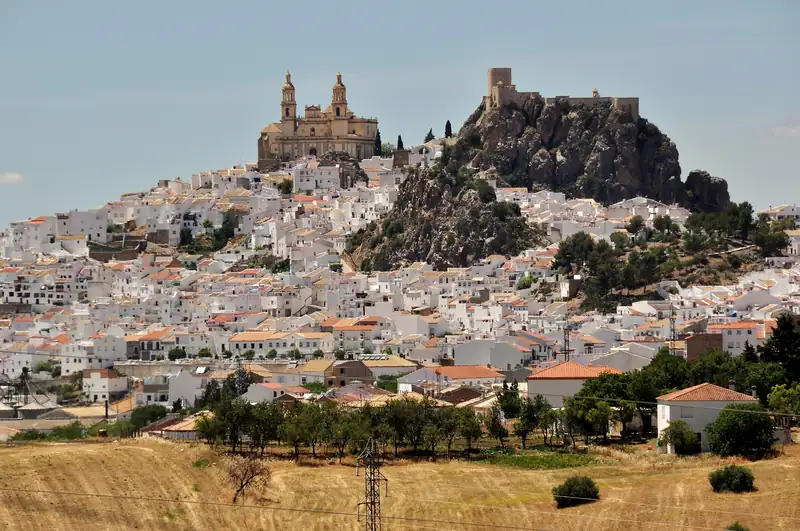
Olvera is the white village as most people picture one: a hill of white houses rising to a Moorish castle on a rock, with a huge pale church beside it. It is a working town of 7,842 people (INE, 2025), in olive country on the northern edge of the Sierra de Cádiz, and only 15 km from Setenil de las Bodegas.
Most visitors give it an hour or two. That is enough for the castle, the museum and the church, and the town is easy to pair with Setenil in the same morning or afternoon.
Olvera castle
The castle is why you come. Olvera’s tourism office dates it to the late 12th century. It was part of the defences of the Nasrid kingdom of Granada until Christian troops took it in 1327, after which it held the line for Castile. It stands at 623 m, and from the top you look out over the country where the two sides faced each other for more than a century and a half. The tourism office says the position let defenders watch the whole line of frontier castles.
Walls, towers and the keep survive, according to Cádiz’s provincial tourism board.
Tickets and hours. In October 2026 the town’s tourism website listed a joint ticket of €2 for the castle and the La Cilla museum, free for registered residents. Two pages on the same site give different opening hours, and both change between summer and winter. Buy the ticket at the tourist office in La Cilla and ask there.
Below the castle, the Barrio de la Villa sits on the footprint of the medieval town, with stretches of wall between the houses. The tourism office lists it as a free, open-air area, so you can wander it at any time.
La Cilla museum
La Cilla, on Plaza de la Iglesia, was built under the lordship of the House of Osuna to store the grain and produce owed to the duchy from the town’s harvests. It later served as the municipal jail and then as a wine press and bodega. Restored, it now holds the tourist office and the museum “Olvera, la Frontera y los Castillos”, about the frontier between Castile and Granada, plus an archaeological display and the interpretation centre for the Vía Verde.
Visit it before the castle. The museum explains what you are looking at from the top.
The Encarnación church
The Iglesia Arciprestal de Nuestra Señora de la Encarnación is the big neoclassical church next to the castle. It was finished in 1843 on the site of the old Gothic-Mudéjar main church, whose apse survives. Most of the altarpieces inside came from other churches in the town. In October 2026 the tourism site listed entry at €2. Opening times are shorter than the castle’s and differ between the site’s own pages, so time your visit for late morning and check on the day.
Santuario de los Remedios and the Quasimodo pilgrimage
On the edge of town, the 18th-century Santuario de Nuestra Señora de los Remedios houses the patron Virgin of Olvera, crowned in 1956. Entry is free. The sanctuary is the setting for the Romería del Lunes de Quasimodo on the second Monday after Easter. The tourism office calls it the oldest romería in Cádiz province: it has been held since 1715, when the town gave thanks for rain that ended a long drought. Olvera also celebrates its patron on 15 August.
Other stops in town
The tourism office’s list of monuments runs longer than most visitors have time for. A few are easy to add on the walk between the castle and the car:
- Peñón del Sagrado Corazón de Jesús, a rock outcrop dedicated to the Sacred Heart, free and open Tuesday to Sunday.
- Iglesia de la Victoria, free, open in the morning and from early evening.
- Calle Llana, a street of old noble houses you see from outside.
- Lavadero de Pino, the old public washing place, an open space.
The Iglesia del Socorro and the former convent of Caños Santos, outside town, open only for visits arranged in advance. The Castillo de Ayamonte, also called Carastas, is private property. Cádiz’s tourism board traces Olvera’s roots to the Roman settlement of Hippa, or Hippo Nova, but what you see today is Andalusí heritage mixed with later building.
The Vía Verde de la Sierra
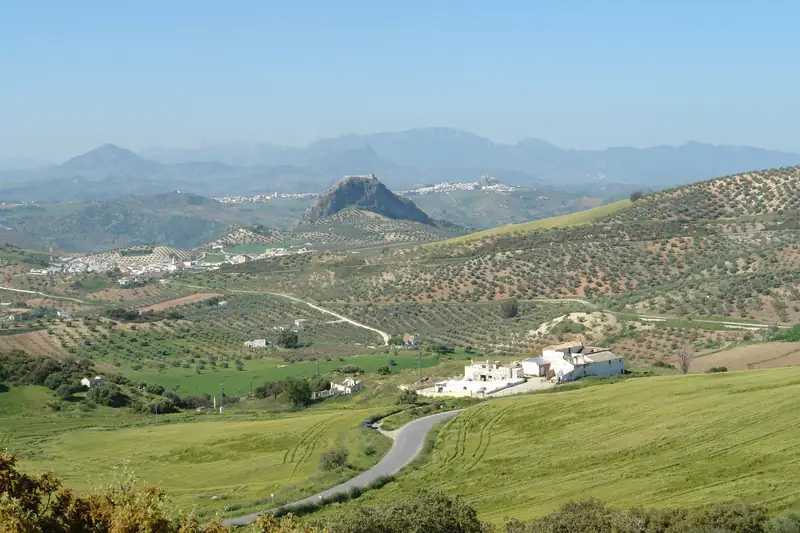
Olvera is the eastern start of the Vía Verde de la Sierra (you will also see it written Via Verde de la Sierra, without the accent), a greenway of more than 36 km to Puerto Serrano along the old Jerez to Almargen railway. The route has 30 tunnels and four viaducts.
The highlight is the Peñón de Zaframagón, a 584 m limestone crag protected as a nature reserve since 1989. Olvera’s tourism office says its griffon vulture colony is the largest in Andalusia and one of the largest in Europe. The river that cut the gorge at Zaframagón is the Guadalporcún, the same river that runs through Setenil’s gorge upstream.
The interpretation centre in La Cilla opens Thursday to Monday, 09:30 to 16:30, with entry at €2 (checked October 2026).
You do not have to ride the whole thing. Any stretch works as an out-and-back from Olvera.
Olvera and Setenil in one trip
The two towns are 15 km apart, about 25 minutes by car, and they make a good contrast. Setenil hides in a gorge with houses tucked under the rock. Olvera stands on a hill and shows itself from miles away.
If you have a morning, do Setenil first, before the tour coaches arrive mid-morning, then drive to Olvera for the castle and lunch. Our Setenil walking route covers the rock streets and the Setenil castle keep, which makes a good comparison with Olvera’s.
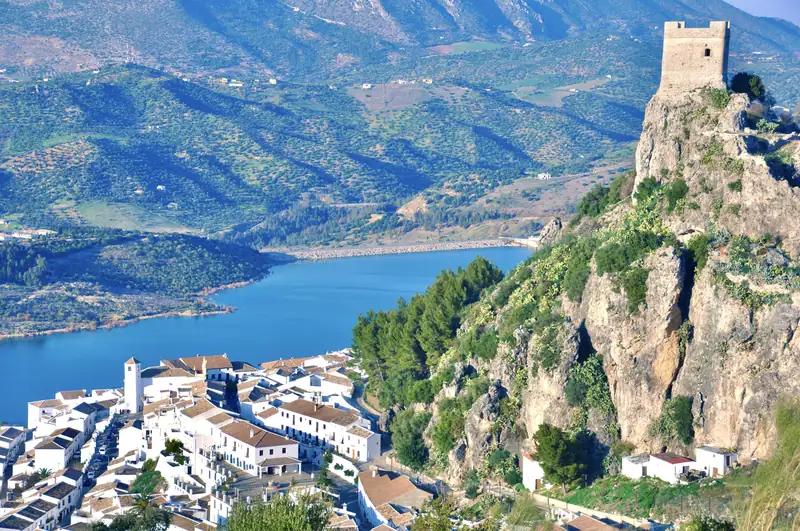
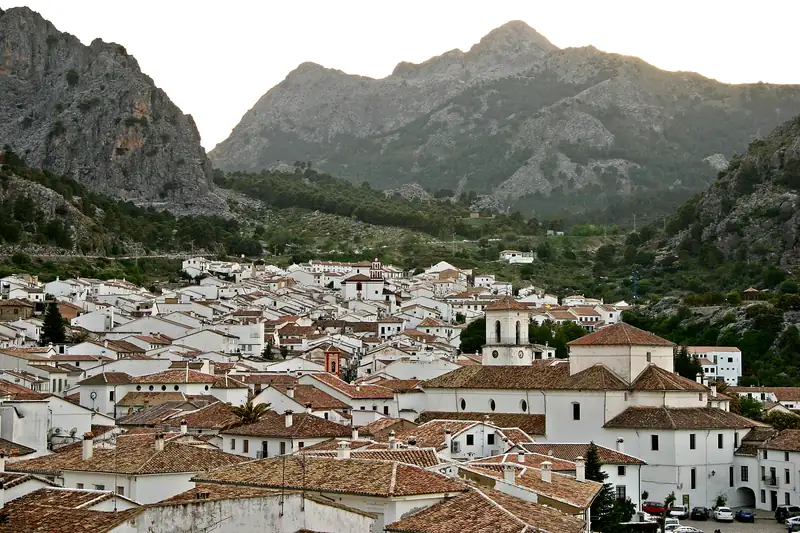
With a full day, keep going: Zahara de la Sierra is about 29 km from Olvera and Grazalema about 41 km. Our white villages route strings them into a loop from Ronda. Arcos de la Frontera is further west, about 68 km.
Parking. The tourism site lists car parks on Calle Lepanto, Vereda Ancha and Avenida Manuel de Falla, one in the old town and one on the way up to the church. The streets near the castle are steep and narrow, so park lower down and walk.
Getting to Olvera
Olvera is a driving destination. From Ronda it is about 50 minutes by road, and from Seville you come in on the A-384, the same road the town hall of Setenil recommends for reaching Setenil from Seville. None of the day tours we list stops in Olvera, so without a car the easiest compromise is a tour to Setenil and Ronda, such as our top pick from Málaga, which gives you an hour in Setenil, and a separate trip to Olvera.