The best things to do in Setenil de las Bodegas are walking the two rock-roofed streets, Cuevas del Sol and Cuevas de la Sombra, climbing to the castle keep and the Encarnación church, and looking over the rooftops from the Carmen viewpoint. Everything is on foot, and half a day covers it with time for tapas.
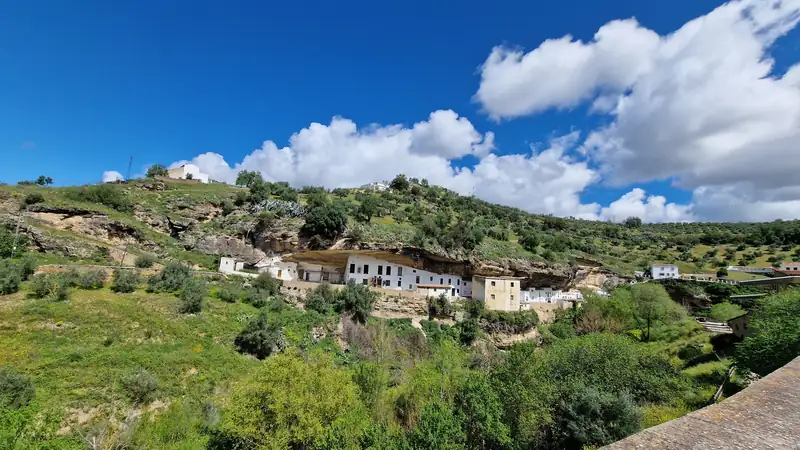
Setenil de las Bodegas is small enough to see on foot in a morning. The old town sits in the gorge of the Río Trejo, the local name for the upper Guadalporcún, with houses tucked under ledges of rock along the bottom and a Moorish keep on the crag above. Almost every sight lies on one loop between the two.
The tourist office splits that loop into two walking routes in its street map: the Ruta de los Reyes Católicos for the monuments and the Ruta de las Calles Cueva for the cave streets. The route below joins them into one walk, starting low in the gorge and climbing to the top.
Get the Setenil map first
The tourist office publishes its “Guía turística & mapa” as a free PDF on turismodesetenil.com. It numbers 14 sights, marks parking and bridges, and shows several viewpoints with a small symbol. The main office is on Calle Villa, inside the old town hall by Plaza de Andalucía.
For something to follow on your phone, our Setenil de las Bodegas map pins every stop on the walking route below, plus the viewpoints and car parks.
Published opening hours for the office vary between sources, so don’t plan around a time you read online. Every listing we found has it open in the morning.
A walking route through Setenil
Park in one of the signed car parks on the edge of the village and walk in. The lanes are narrow and the old town has no parking of its own. Our guide to getting to Setenil lists every car park, including Los Caños, the covered one that charges.
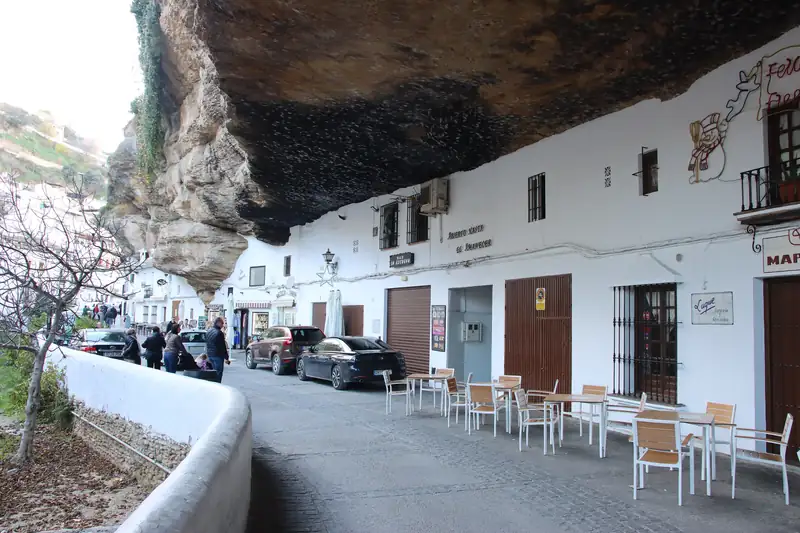
- Calle Cuevas del Sol. The street most people come to see. It faces south, so it gets the most light, and its cave houses and bars sit in natural hollows under the rock. It is the busiest street in town and the place for a terrace drink.
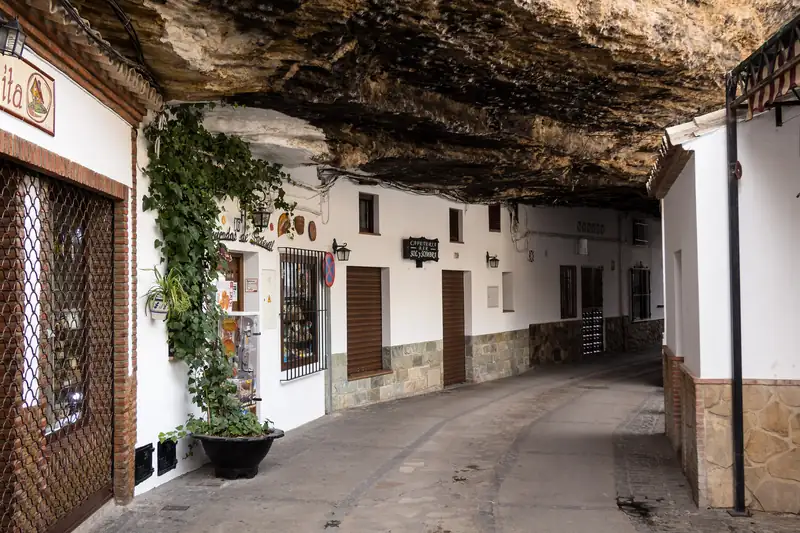
- Calle Cuevas de la Sombra. Here the overhang stretches right across the street and roofs it like a tunnel. Our page on Cuevas del Sol and Cuevas de la Sombra explains how the rock shelters formed and who lived in them.
- Calle Herrería and Calle Calcetas. Narrow, stepped lanes of cave houses that drop towards the river. The tourist office quotes an unnamed writer who called Herrería one of the most beautiful and romantic streets in Andalusia, and it has a corner known as “Bésame en este Rincón” (kiss me in this corner). Calcetas runs below the old Moorish wall.
- Casa de la Damita. A small display of finds from local digs. The star piece is the Damita de Setenil, a Venus figurine about 5,000 years old found in the Calle Calcetas excavations in 1997. We could not confirm its current opening hours.
- The old town hall. The early 16th-century Casa Consistorial, now the tourist office, keeps a Mudéjar wooden ceiling whose lower band carries an inscription recording the conquest by the Catholic Monarchs on 21 September 1484. The tourist office says it is the only ceiling of its kind left in the province.
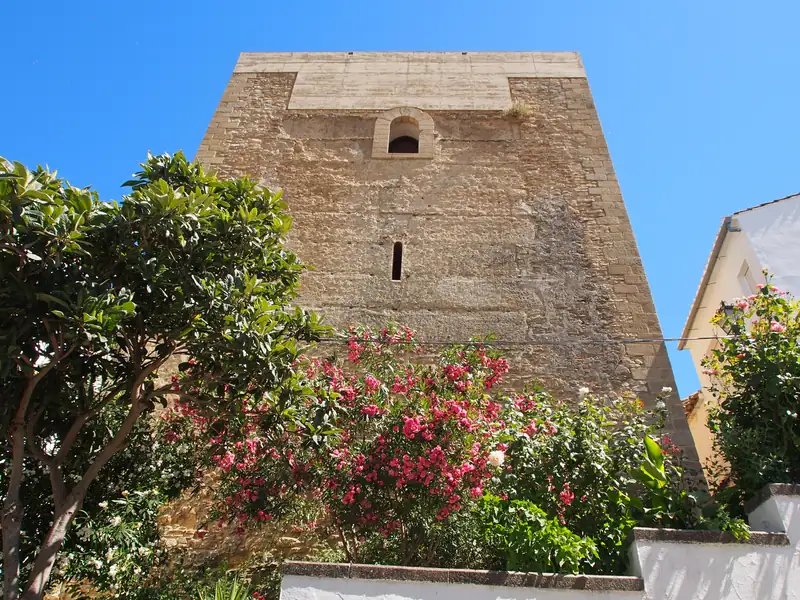
- The castle keep and cistern. The square Torreón, or Torre del Homenaje, is the most striking survivor of the Moorish fortress. Its three floors host temporary exhibitions, and the aljibe (rainwater cistern) just below has two barrel vaults on central pillars. No official source publishes a fee or opening hours, so check at the tourist office. The castle and history page covers the sieges and the 1484 conquest.
- Iglesia de Nuestra Señora de la Encarnación. The parish church was built over the town’s main mosque, with the backing of the Catholic Monarchs. Work began in the late 15th or early 16th century and finished only in 1614, which is why it mixes Gothic, Mudéjar and some Renaissance work. Its main treasure is the Retablo de la Anunciación, a late 15th-century painted altarpiece in three sections.
- Ermita de San Sebastián. A late Gothic hermitage on the highest part of the slope, which the tourist office calls the first Christian building in Setenil after the conquest. A legend about Queen Isabel is attached to its name; the castle and history page explains why historians reject it.
- Mirador del Carmen. Climb the steps to the rocky outcrop beside the 18th-century Ermita del Carmen, home of the town’s patron, the Virgen del Carmen. From the top you look over the white houses, the keep, the wall and the Encarnación church in one view. The tourist office map marks several more viewpoints around town, and one travel guide names the spot at the foot of the keep the Mirador de El Lizón.
- Down to the river. Calle Jabonería and Calle Cabrerizas follow the river, open to the water on one side and lined with cave houses on the other. The tourist office says both were film locations for the 1970s TV series Curro Jiménez. The riverside cave houses of the Cuevas de San Román link the river back up to the town.
One warning: the climbs between stops are steep, with steps and cobbles, so wear proper shoes. The Mirador del Carmen alone is a long flight of steps.
Food to try in Setenil
Cave bars and tapas terraces line Calle Cuevas del Sol and Calle Cuevas de la Sombra. We don’t name individual bars, because the official directory is undated and businesses change hands. Look for these dishes instead:
- Sopas cortijeras: the town’s signature dish of bread, olive oil, asparagus and a poached egg.
- Masitas: Andalusia’s tourism board describes them as a traditional Setenil hamburger.
- Chacinas: cured pork, including chorizo, once made at family pig slaughters (matanzas).
- Revueltos de espárragos: scrambled eggs with asparagus.
- Local sweets: cortadillos, empanadillas made with olive oil and, in season, pestiños.
The town hall calls extra virgin olive oil “el producto más representativo” of Setenil’s food and economy. Wine is back too, in a small way. The name “de las Bodegas” refers to the town’s old wineries, and the town hall reports a small, growing wine industry making the first Setenil reds in many years.
Walks beyond the village
The tourist office brochure maps eight walking routes from town. An easy one is the Ruta de los Molinos, 3.3 km to the Salto de la Molinilla. The Ruta de los Bandoleros runs 10.5 km to the Roman ruins of Acinipo, but that one is on hold: Acinipo has been closed since storms damaged its access road in March 2025.
When to go
Spring and autumn are the most comfortable months, and April to June is peak season. Coaches arrive from mid-morning to mid-afternoon, so if you are driving yourself, come before 10:00 or after 18:00 in summer and at weekends. July and August average highs in the low 30s °C, and the shaded rock streets stay cooler than the rest of town. Our best time to visit Andalusia guide goes month by month.
The festival calendar adds a reason to time a visit:
- January: the feast of San Sebastián, on 21 January.
- March or April: Holy Week, with processions by rival brotherhoods.
- August: the Feria, on the second weekend, with a daytime fair on Calle Cuevas del Sol.
- October: Moros y Cristianos, around 21 October, commemorating the 1484 conquest.
- December: a Christmas market around the 6 December holiday.
Dates move each year, so confirm them with the town hall before you travel.
To see the cave streets after the coaches have gone, stay the night. Most day visitors leave in the afternoon for Ronda or Grazalema. Our guide to hotels in Setenil covers the one hotel in the old town and the cave houses around it.
Seeing Setenil on a tour
If you are not driving, a day tour is the easiest way in. Coaches from Málaga, Seville and the Costa del Sol pair Setenil with Ronda, giving you anywhere from 45 minutes to over two hours in Setenil. Some Málaga departures include a ride on a little train, according to their listings. A half-day trip runs from Ronda itself for anyone staying there. Reviews say a one-hour stop can feel rushed, so pick a longer one if Setenil is the main reason you are going. Our top pick is the semi-private day from Málaga: seven people at most, with a guided walk of almost two hours through the cave streets. The full list is on our tours page, and the things to do in Ronda guide covers the other half of the day.