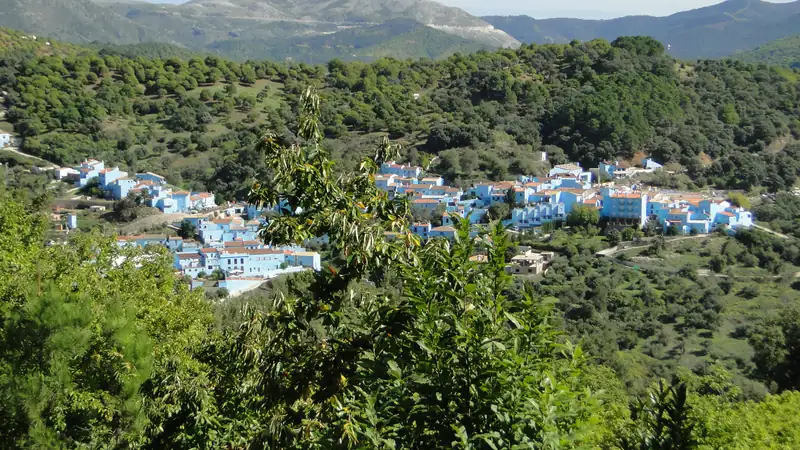
Júzcar is a village of 208 people in the Genal valley, about 21 km from Ronda, painted blue in 2011 for Sony's Spanish launch of The Smurfs 3D. Residents voted to stay blue. The Smurf branding ended in 2017 after a rights dispute, but the houses are still blue and the village now calls itself La Aldea Azul.
Júzcar is the blue village. A small white village in the Genal valley, south of Ronda, it was painted Smurf blue in 2011 to launch a film, and it never went back. The village has 208 residents (INE, 2025) and sits about 21 km from Ronda by road, roughly 35 minutes, or about an hour from Setenil de las Bodegas.
The Smurf branding is gone since a rights dispute in 2017. The blue houses are not. For tourism the village calls itself La Aldea Azul, the Blue Village, and most visitors give it an hour on a drive out of Ronda.
In 2011 Sony needed a stunt for the Spanish release of The Smurfs 3D. Júzcar, a white village of a couple of hundred people on a slope above the río Genal, got the job. Every building was painted blue, including the church and the town hall, according to NBC News, which ran a Reuters report in 2013. Spanish Wikipedia credits the idea to Bungalow25, a Madrid advertising agency working on the launch, and dates the premiere event in the village to 16 June 2011. The most cited figure for the paint is about 4,000 litres.
The paint was meant to be temporary. Promoters had pledged to repaint Júzcar white once the campaign was over.
What happened after
Visitors came instead. By July 2013 the mayor, David Fernández, estimated that about 210,000 tourists had visited since the paint job two years earlier (NBC News). For a village that small, in an area with high unemployment, that changed the arithmetic. In December 2011 the town hall held a vote on whether to go back to white or stay blue, and blue won by a large margin.
The trouble came from the characters, not the colour. The Local reported in August 2017 that the village had agreed to pay 12% of Smurf-related income in royalties to the heirs of Pierre Culliford, known as Peyo, the Belgian artist who created the Smurfs. That arrangement broke down. A council notice said Júzcar had “lost the authorization to market itself as a Smurf town”, and from 15 August 2017 Smurf statues, references to the brand and Smurf-themed activities had to stop.
The village kept the paint and changed the name it uses for tourism to La Aldea Azul. English Wikipedia says the last full repaint was in 2019, with the paint supplied by the provincial and village governments and building owners doing the work.
How blue is it now? The Olive Press visited in May 2026 and found that much of the paint has washed off, with locals touching up some houses now and then. Expect a blue village with faded patches, not a film set.
What to see in Júzcar today
The village takes an hour on foot. What you will find, from the most recent reporting:
- The blue streets and the church. The parish church was painted along with everything else, and it is the photo most people come for.
- Wall paintings and street art. The Olive Press describes murals and occasional cartoon figures, some of them faded.
- A zip-line from the top of the village, open only in high season according to the same report. A Smurf-themed playground was closed after landslides.
- Viewpoints on the drive in, which the Olive Press also recommends.
The Real Fábrica de Hojalata. Down by the river is an 18th-century royal tinplate factory, built under Philip V. Spanish Wikipedia calls it the first in Spain. Today it houses a private winery, the Bodega Antigua Real Fábrica de Hojalata San Miguel. The Junta de Andalucía’s tourism site lists tastings for groups at €35 a person for up to five people and €30 for six or more (checked October 2026); book before you go.
The Bosque de Cobre. In autumn the chestnut woods of the Genal valley turn orange, gold and ochre. The Junta’s tourism site calls this the Bosque de Cobre, the Copper Forest, and lists Júzcar among the villages it surrounds. The chestnut harvest runs through September and October, and the road from Júzcar towards Pujerra and Igualeja passes through the woods.
Canyoning. If you want more than a stroll, one GetYourGuide trip takes small groups down the Sima del Diablo ravine in the Genal valley, with three abseils beside waterfalls and two natural slides, meeting at the Júzcar municipal pool. It is new and has no reviews yet.
Practical details
| Item |
Detail (checked October 2026) |
| From Ronda |
About 21 km, about 35 minutes |
| From Setenil de las Bodegas |
About 38 km, about 1 hour |
| From Marbella |
About 59 km, about 1 hour 10 minutes |
| Population |
208 (INE, 1 January 2025) |
| Real Fábrica de Hojalata wine tasting |
€35 per person (groups up to 5), €30 (6 or more), as listed by the Junta’s tourism site; book ahead |
| Smurf branding |
Ended 15 August 2017; the village markets itself as La Aldea Azul |
Distances are road distances from the OpenStreetMap router, rounded up for mountain driving.
Getting to Júzcar
Drive. From Ronda, take the A-397 towards San Pedro de Alcántara and turn off onto the narrow local roads that drop into the Genal valley. The last stretch is slow, with tight bends, so allow 35 minutes for 21 km. None of the day tours on the tours page stops in Júzcar.
From the Costa del Sol the same A-397 climbs from San Pedro towards Ronda, so Júzcar is a natural detour on the Marbella to Ronda drive. From Málaga, see Málaga to Ronda for the main routes.
Júzcar with Ronda and Setenil
Júzcar alone does not fill a day. It works best as a morning or late-afternoon add-on to Ronda. A simple plan: Júzcar first thing, back to Ronda for lunch and the Puente Nuevo, then north to Setenil, 19 km from Ronda, for its streets built under the rock. The things to do in Ronda guide covers the town itself, and the white villages route covers the Cádiz side.
Ronda is the obvious base for all three. The where to stay in Ronda guide lists hotels by area, and the Setenil hotels guide covers staying in Setenil itself.