Stops in Setenil
White Towns and Ronda: Day Excursion from Seville.
9 hours
Eight people in a van with hotel pickup, stopping at Zahara de la Sierra, Setenil and Ronda, with a guide at each and 75 minutes in Setenil.
from$107
Check availability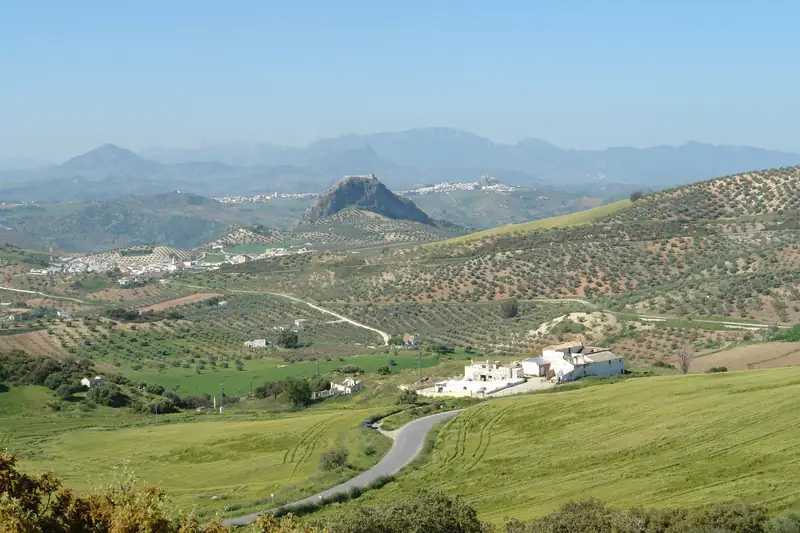
The white villages of Andalusia, or pueblos blancos, are hill towns of whitewashed houses in the mountains between Ronda, Seville and Jerez. The best-known cluster sits in the Sierra de Cádiz. A one-day loop from Ronda takes in Setenil, Olvera, Zahara and Grazalema in about 110 km; Arcos de la Frontera adds a second day.
Andalusia’s white villages are hill towns built for a hot climate and a dangerous frontier. Houses are limewashed white, streets climb in steps, and many villages sit under the ruins of a Moorish castle. The thickest cluster is in the Sierra de Cádiz, inland from Jerez and west of Ronda, and that is the area this guide covers.
You can drive the best of them in a day. The roads are slow and the villages small, so the trick is choosing four or five and not trying to tick off all of them.
“Pueblos blancos” simply means white villages. The name is descriptive, not official, and you will find whitewashed villages across inland Andalusia, from the Sierra de Cádiz to the Axarquía east of Málaga.
The white has practical roots. The Olive Press (August 2022) gives the usual explanation: the white walls reflect sunlight and keep houses cooler in summer, and slaked lime worked as an insect repellent and disinfectant, which made it useful during the 19th-century cholera outbreaks. The same piece links the custom to the centuries of Islamic rule. Treat that last part as the popular story.
What the villages share is the frontier. In the 14th and 15th centuries this was the border between Castile and the Nasrid kingdom of Granada, which is why so many of them have a castle on top. Olvera’s fell to Castile in 1327. Zahara’s capture by Granada in 1481 gave Castile its pretext for the final war. Setenil fell in September 1484.
The Ruta de los Pueblos Blancos is a tourism route through the Sierra de Cádiz, the mountainous north-east of Cádiz province. Lists of the villages on it vary from source to source, so ignore anyone quoting an exact count. Cádiz’s provincial tourism board calls Arcos de la Frontera the gateway to the route, which makes sense if you arrive from Jerez or Seville.
Much of the route runs through the Sierra de Grazalema Natural Park, a UNESCO Biosphere Reserve since 1977. Zahara and Grazalema are inside the reserve. Setenil and Olvera, further north, are not.
| Village | Why go | From Setenil by road |
|---|---|---|
| Setenil de las Bodegas | Houses and bars built under overhangs of rock | Start here |
| Olvera | Castle on a crag, the Vía Verde rail trail | 15 km, about 25 min |
| Zahara de la Sierra | Hilltop keep above a turquoise reservoir | 32 km, about 50 min |
| Grazalema | Mountain village, hiking base, famous for rain | 31 km, about 50 min |
| Arcos de la Frontera | Old town on a cliff above the Guadalete | 74 km, about 1 h 20 |
Distances are road kilometres between town centres, calculated with OpenStreetMap routing. Mountain roads are slower than the maps think, so add a margin.
Ronda sits in the middle of the white villages, so the easiest way to picture the Ruta de los Pueblos Blancos map is as spokes from Ronda. The Sierra de Cádiz villages lie to the north and west; the Serranía de Ronda villages and caves lie to the south and west.
| Village or sight | Direction from Ronda | Road distance | Drive (approx.) | Known for |
|---|---|---|---|---|
| Cueva del Gato, Benaoján | West | 15 km | 25 min | A cave near Benaoján |
| Setenil de las Bodegas | North | 19 km | 30 min | Streets under overhangs of rock |
| Júzcar | South | 22 km | 35 min | Painted blue in 2011 for a Smurfs film premiere |
| El Gastor | North-west | 31 km | 35 min | Called the Balcony of the White Towns |
| Grazalema | West | 32 km | 35 min | Hiking base, famous for rain |
| Olvera | North | 33 km | 50 min | Castle on a crag, the Vía Verde |
| Zahara de la Sierra | North-west | 34 km | 45 min | Keep above a turquoise reservoir |
| Gaucín | South-west | 36 km | 45 min | Serranía de Ronda village in the Ronda wine subzone |
| Algodonales | North-west | 36 km | 40 min | On the Seville road, 9 km from Zahara |
| Ubrique | West | 49 km | 1 h 5 min | Town of about 16,600 in the Grazalema reserve |
| Arcos de la Frontera | West | 84 km | 1 h 20 | Old town on a cliff above the Guadalete |
We worked these out with OpenStreetMap routing between town centres in October 2026, and rounded the drive times up because the router assumes empty roads. Setenil’s 19 km is the figure from its own route data. El Gastor is covered in our Zahara guide, which shares its reservoir. For the streets of Setenil itself, use our Setenil de las Bodegas map.
Most white villages perch on a hill. Setenil de las Bodegas hides in a gorge instead. The old town is built into the cliffs of the Río Trejo, and on two streets, Cuevas del Sol and Cuevas de la Sombra, the rock hangs over the houses like a roof. In Cuevas de la Sombra it covers the whole street.
It is also the closest to Ronda, 19 km by road, and has belonged to Los Pueblos Más Bonitos de España since 2019. That proximity is why so many day tours pair the two. Our guide to the rock streets explains how the cave houses work, and things to do in Setenil has a walking route with the castle keep and viewpoints.
Setenil gets busy from mid-morning to mid-afternoon, when coaches arrive from Málaga and Seville. If you are driving the loop below, start there, or sleep in the village the night before; our guide to hotels in Setenil de las Bodegas lists the options.
This loop covers the four villages that matter most and brings you back to Ronda for the night. It is about 112 km and roughly two and a half hours of pure driving by OpenStreetMap’s estimate, so budget a full day.
Driving clockwise works too. Doing Setenil first is the point: it is the village most affected by coach crowds.
Arcos is the odd one out on the map, 48 km west of Grazalema on the way to Jerez. If you are coming from Seville or the coast, start there on day one, sleep in Grazalema or Zahara, and finish with Olvera and Setenil on day two before Ronda. Arcos is larger than the mountain villages, with a population of about 31,000, and its old town sits on a sandstone cliff above the Guadalete.
Day tours are the realistic alternative. From Seville, small-group trips stop in Zahara, Setenil and Ronda in one day; our top pick takes eight people in a van with hotel pickup and a guide at each stop. Most tours from Málaga and the Costa del Sol pair Ronda with Setenil only. One popular Seville trip goes through Zahara and Grazalema with an olive oil mill stop but skips Setenil, so read the itinerary before you book.
Public transport is thin. From Málaga, one Autocares Sierra de las Nieves bus a day, Monday to Saturday, runs through Ronda to Setenil; from Seville there is no direct bus. Between Ronda and Setenil, line 66 takes 45 minutes, with no service on Sundays or public holidays (checked October 2026). Rail is no help either: in October 2026 no trains run to Ronda or Setenil, because Renfe has replaced the line with buses while Adif rebuilds it, with work expected to last into autumn 2027. Check renfe.com before you plan around rail. See day trips from Seville and day trips from Málaga for the wider picture, or compare the white village tours directly.
Spring and autumn are best: mild days, green hills and the hiking trails open. July and August are hot in the afternoons, and some park trails close for fire risk from 1 June to 15 October. Winter is quiet and can be very wet, especially in Grazalema. Our best time to visit Andalusia guide has a month-by-month table for Ronda and a festival calendar for the villages.
9 hours
Eight people in a van with hotel pickup, stopping at Zahara de la Sierra, Setenil and Ronda, with a guide at each and 75 minutes in Setenil.
from$107
Check availability9 hours
A small-group minibus that fits down the narrow lanes of Zahara and Setenil, with guided stops in both before a longer afternoon in Ronda.
from$107
Check availability10 hours
A Sierra de Grazalema loop from Seville through Zahara and Grazalema, with an olive oil mill visit and an afternoon in Ronda, but no Setenil stop.
from$89
Check availability9 hours
The most-booked Setenil day trip: about four hours in Ronda, then an hour in Setenil with the little shuttle train, plus an optional wine and cured-meat tasting in Ronda.
from$35
Check availabilityPrices and ratings were taken from GetYourGuide and can change. Booking through these links supports this site at no extra cost to you.
They are the pueblos blancos: small towns of whitewashed houses, usually on a hilltop or ridge under a Moorish castle, in the mountains of inland Andalusia. The best-known group lies in the Sierra de Cádiz, between Ronda, Seville and Jerez, and Cádiz's tourism board promotes them as the Ruta de los Pueblos Blancos. Setenil, Olvera, Zahara, Grazalema and Arcos are the usual highlights.
It depends what you want to see. Grazalema, Zahara and Setenil all belong to Los Pueblos Más Bonitos de España, an association of Spain's prettiest villages. Setenil is the unusual one, with streets under overhangs of rock. Zahara has the castle and the turquoise reservoir. Cádiz's tourism board calls Arcos one of the most beautiful towns in Spain.
One full day by car covers the core loop from Ronda: Setenil, Olvera, Zahara and Grazalema, about 112 km of mountain roads. Two days lets you add Arcos de la Frontera and slow down, with a night in Grazalema, Zahara or Ronda. Hikers need longer, because the best trails in the Sierra de Grazalema need a permit booked in advance.
Only partly. Day tours from Seville stop in Zahara, Setenil and Ronda, and most tours from Málaga cover Ronda and Setenil. Buses between the villages are sparse: Ronda to Setenil runs Monday to Saturday only, and in October 2026 no trains run to Ronda or Setenil while the line is rebuilt. A car or a tour is the practical way.
Frigiliana is a white village, but it is not near Ronda. It sits in La Axarquía, east of Málaga, about 156 km and two and a half hours by road from Setenil. If you are staying on the Costa del Sol east of Málaga it makes a separate trip. The Sierra de Cádiz villages on this page cluster within an hour of Ronda.
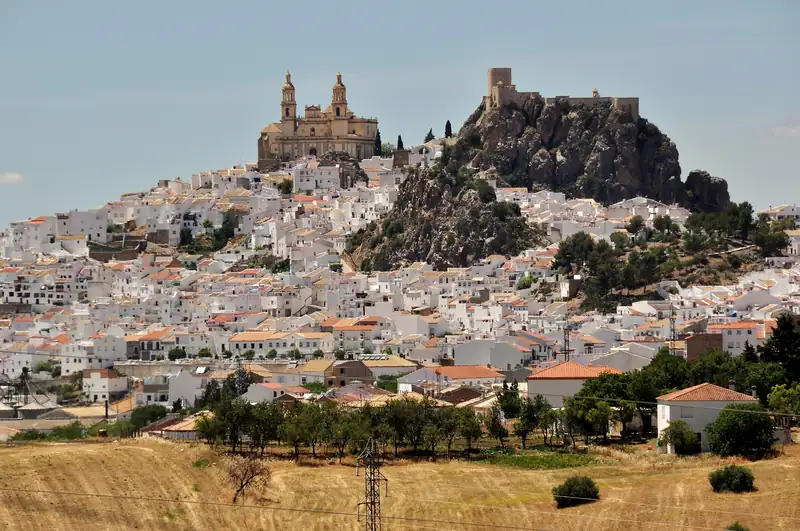
Olvera is a white town of about 7,800 people in the Sierra de Cádiz, 15 km from Setenil de las Bodegas.
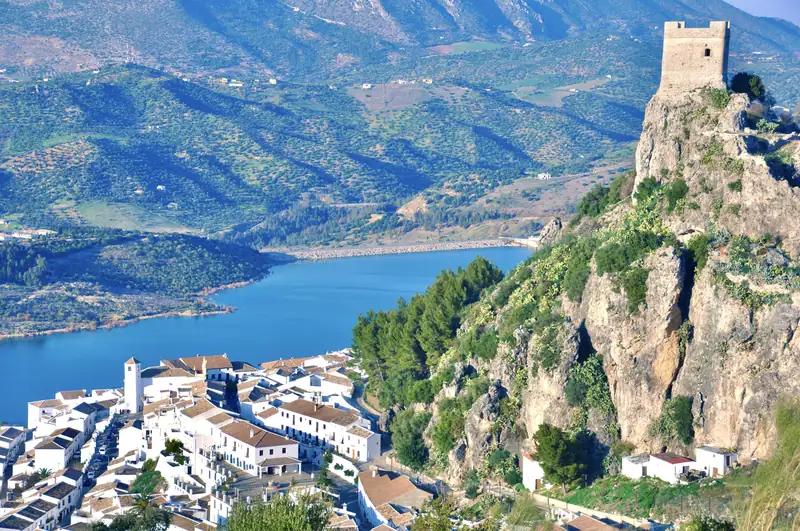
Zahara de la Sierra is a white village of about 1,300 people on a hillside inside the Sierra de Grazalema Natural Park, crowned by a 13th-century Nasrid castle and overlooking the turquoise Zahara-El Gastor reservoir.
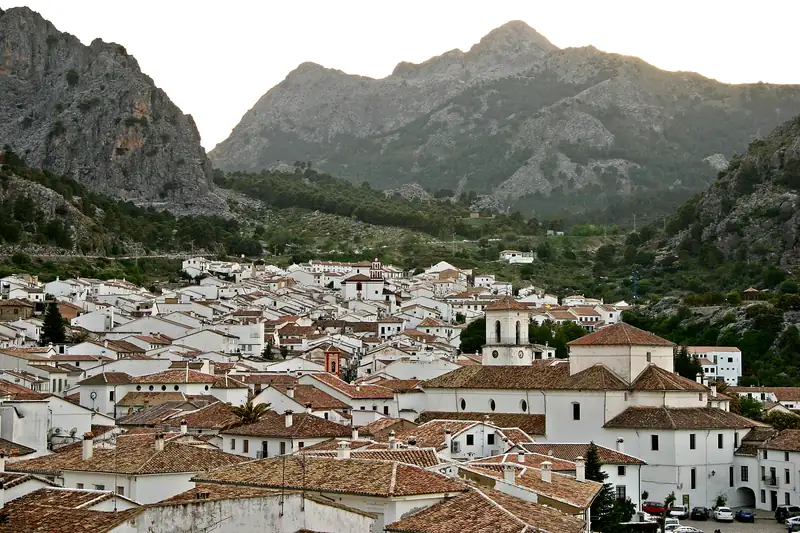
Grazalema is a mountain village of about 2,000 people inside the Sierra de Grazalema Natural Park, 31 km from Setenil.
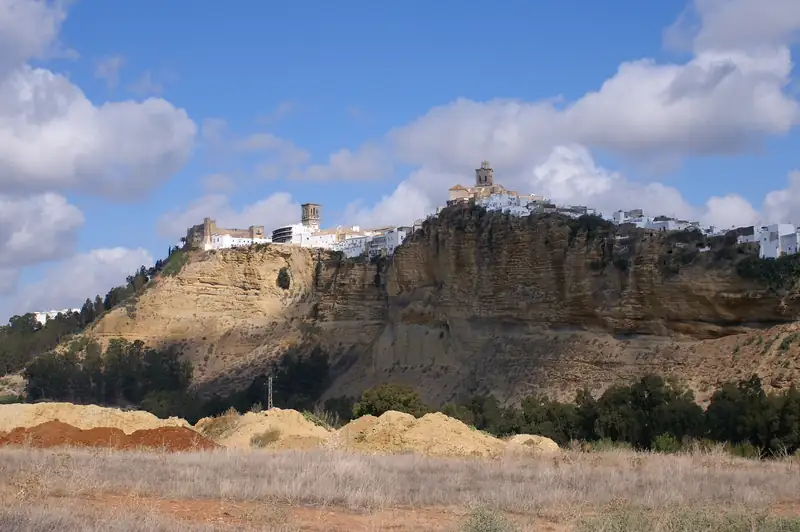
Arcos de la Frontera is a town of about 31,000 people whose old town sits on a sandstone ridge above vertical cliffs over the Río Guadalete.
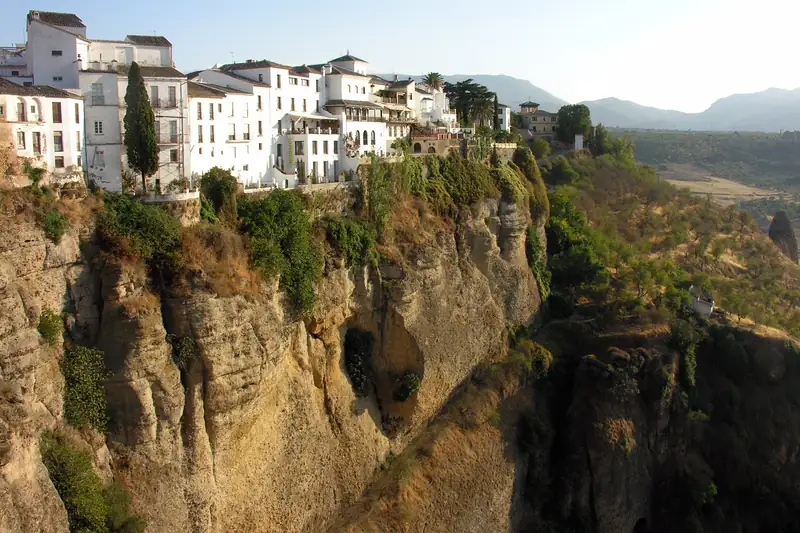
Ronda's main sight is the Puente Nuevo, the 18th-century bridge over the El Tajo gorge, which you can see from above, from inside and from below.